It's not that the regulation is unclear - it's that pulling the data, applying the right methodology, and formatting it correctly for Companies House takes time most finance teams don't have.
Energy bills, fleet logs, and invoices in different systems - manual stitching is error-prone.
SECR hits inside your accounts deadline when finance has no spare capacity.
SECR lands on finance with no carbon accounting background — gaps follow.
DEFRA updates annually. Using last year's figures is a common SECR audit finding.

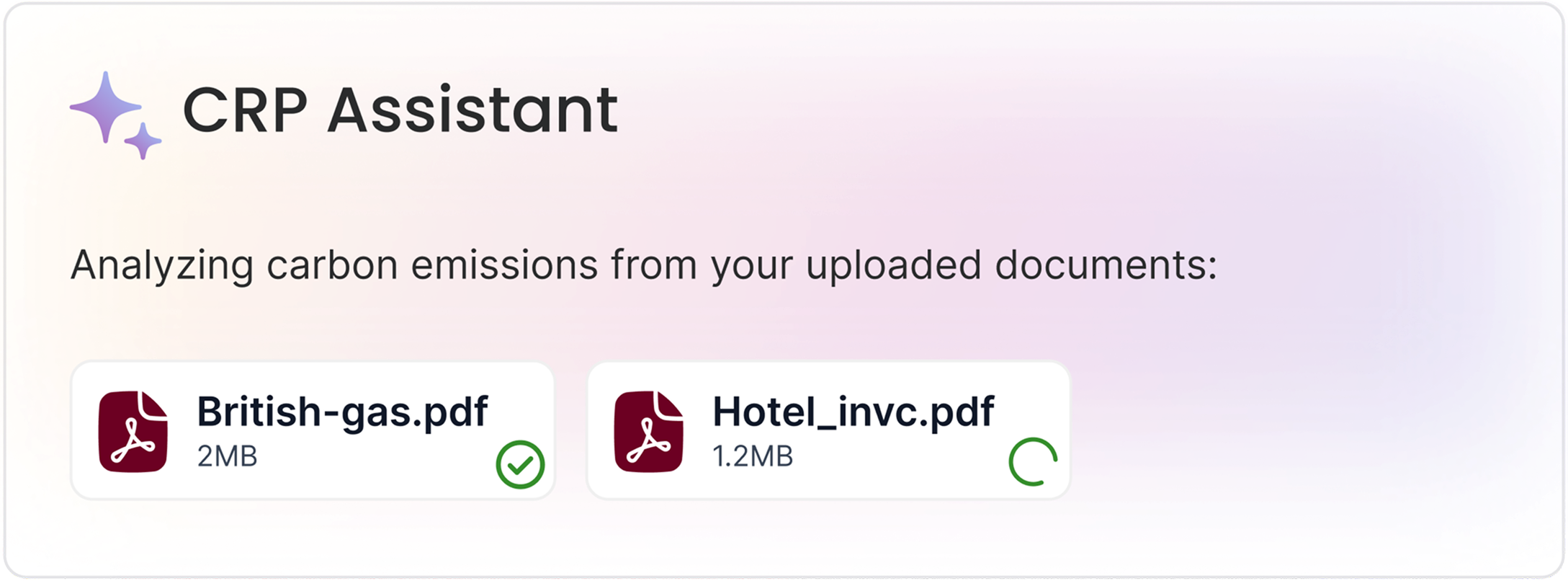
Upload bills, CSVs, or connect directly to your energy provider. We handle electricity, gas, fuel, and fleet — all in one place.

We apply the current DEFRA GHG conversion factors across Scope 1 and 2 — and Scope 3 if you're a quoted company — with zero manual input.

Download your SECR disclosure in the correct format for your Directors' Report, with year-on-year comparatives and intensity metrics included.

Own the accounts process without outsourcing SECR to a consultant. Done in an afternoon, not a week.
Specialized calculations for projects, materials, and equipment emissions with supplier integration.
Process-specific emissions tracking with production efficiency metrics and reduction opportunities.
Compliant reporting that addresses unique healthcare operations and patient care considerations.
Supply chain mapping with product lifecycle analysis and consumer-facing sustainability reporting.
Get filing-ready language for the Directors' Report with no back-and-forth with sustainability teams.
Spend time on strategy, not data wrangling. Use our platform to manage multiple entities from one dashboard.
Digital carbon footprinting with accurate assessment of cloud services, hardware, and remote work.
Templates aligned with government standards and public accountability requirements.
Transportation emissions optimization with route planning and fleet management integration.
Event-based carbon accounting with audience travel and temporary infrastructure tracking.
White-label reporting for client portfolios. Deliver SECR as a service without building a carbon practice from scratch.
Production and distribution emissions analysis with renewable integration planning.
Office-based reporting with employee commuting and digital infrastructure assessment.
No matter your team or sector, CRP ensures compliance with automated, tailored reports. Our specialists can help you identify the most relevant data points for your sector.
Get Started
Streamlined Energy and Carbon Reporting (SECR) is a UK government regulation that requires large companies and LLPs to disclose their energy use and carbon emissions in their annual Directors' Report. It applies to you if your organisation meets at least two of: 250+ employees, £36m+ turnover, or £18m+ balance sheet.
Quoted companies face additional Scope 3 requirements. If you use less than 40 MWh of energy in the period, you may qualify for a low-energy exemption - but you still need to state this in your report.
Yes. SECR has been mandatory for qualifying organisations since financial years beginning on or after 1 April 2019. It is enforced through the Companies Act 2006 — a Directors' Report that omits required SECR disclosures is non-compliant and can be rejected at Companies House. Directors can be held personally liable for approving accounts that fail to meet the requirements.
At minimum you need: electricity bills (kWh), gas bills (kWh or m³), and fleet/vehicle fuel records for the reporting period. Quoted companies must also include business travel data for Scope 3. You'll need prior-year figures from year two onwards for the mandatory comparative. crp.eco walks you through exactly what's needed and flags any gaps before you generate your report.
Manual SECR reporting — collecting bills, applying DEFRA conversion factors, building the comparative, drafting the Directors' Report language — typically takes a finance team 8 to 20 hours, often spread across weeks of chasing. With crp.eco, most teams complete their first report in under two hours, with renewals taking under 30 minutes once prior-year data is stored.
SECR non-compliance doesn't carry a direct financial fine in the way some other regulations do, but the consequences are serious. Your accounts can be rejected by Companies House, delaying your filing and creating legal exposure for directors personally. Beyond the legal risk, incomplete SECR disclosures are increasingly visible to investors, lenders, and procurement teams — particularly those running ESG screening or supply chain due diligence.
SECR calculations must use the UK government's official GHG conversion factors, published annually by DEFRA. These change every year — using the previous year's factors is one of the most common errors found in SECR audits. Crp.eco automatically applies the current year's DEFRA factors the moment they're published, so you never need to check manually or risk filing with outdated figures.
ESOS (Energy Savings Opportunity Scheme) is an energy audit you commission every four years — it assesses where you could reduce consumption but doesn't require public disclosure. SECR is annual and requires you to publicly disclose your actual energy use and carbon emissions in your Directors' Report. Many companies use their ESOS audit data to inform their SECR figures, but they're separate obligations with different deadlines and scopes.
It depends on your company type. Unquoted companies and LLPs only need to report UK energy use and emissions. Quoted companies must report global Scope 1 and 2 emissions and disclose UK energy use as a separate line. If you operate internationally, crp.eco lets you input by geography and automatically splits the figures correctly for your filing type.
Yes. crp.eco supports multi-entity reporting from a single dashboard — ideal for group finance teams managing several subsidiaries, or accountants and advisors delivering SECR as a service to a portfolio of clients. Each entity has its own reporting history, and group-level consolidation is handled automatically where required.
Independent verification is not legally required under SECR. However, it is strongly recommended - particularly for quoted companies where institutional investors and ESG rating agencies will scrutinise the numbers. Verified data also reduces your exposure if Companies House or auditors query your methodology. SECR.uk generates a full audit trail and methodology statement with every report, which makes third-party verification significantly faster and cheaper if you choose to pursue it.
If you've already filed accounts without SECR disclosures, you may need to refile amended accounts at Companies House — speak to your auditor or company secretary about the process. Going forward, SECR.uk can backfill prior-year figures so your next report includes the mandatory comparative, even if the baseline year was missed. Don't ignore it: regulators and investors are paying closer attention to SECR compliance as ESG scrutiny increases.